|
Equine Kingdom Riding Academy
is no longer in operation. These more than 2,000 unique pages are provided for historical and educational reference. |
||
 |
||
|
|
|



-Gymnastics To Increase Your Horse's Flexibility - |
|
|
By: Shannon Margolis This exercise from eventing coach Jim Wofford's book Gymnastics: Systematic Training for Jumping Horses will help you increase your horse's gymnastic ability, balance and flexibility using cavalletti poles. Editor's Note: This technique is one of 23 gymnastics designed to improve your horse's jumping skills that Wofford describes in his illustrated book, Gymnastics: Systematic Training for Jumping Horses. After you have warmed your horse up at the walk, trot and canter, then trot into the exercise marked A in the sketch at right. Cavalletti set at this distance (4 ft., 6 in. apart) will produce a working trot for most horses.
At the posting trot, proceed on a circle in either direction through B. Keep your horse's direction adjusted so that the length of his step on the curve feels the same as it did over A. Once you and your horse have become adept at this you can then start to enter, for example, closer to the 3 ft (90 cm) end of the poles where the distance is shorter and then let the horse angle away from the center of the circle. This will cause your horse to go from a working trot to a medium trot or possibly, if your angle becomes too great, even take a couple of steps of extended trot. If your horse takes two steps between the poles or breaks into a canter, you have probably asked too much flexibility from him. Aim closer to the 3 ft (90 cm) end of the curve, and enter B again at the posting trot. Alternatively, you can enter from the outside of B, where the rails are farther apart. This will cause your horse to take quite a large step at first. Angle in towards the 3 ft (90 cm) distance between the last two poles. This will bring your horse back to a working trot or even a slightly collected trot. Having worked in both directions over B, including being able to angle both ways, you can then proceed to C. The poles positioned at C, set at 5 ft. (1.5 m) apart, will produce the sensation of extended trot, and you may find that your horse cannot reach enough in his fourth step to get out over the last pole without "chipping in" an additional step. Simply remove the last pole and continue. You will find that, after a couple of days' work over cavalletti, your horse gets the message and you can replace the fourth pole. You should work in both directions over the 5 ft (1.5 m) poles at C until your horse can maintain his regularity and length of step. After a short break proceed to D. These four rails on the ground, set at 4 ft. (1.2 m) apart, will produce a collected trot. Although these exercises can be ridden either posting or sitting, you should definitely use rising trot until your horse becomes adjusted to them. Again, work both ways through D until your horse is relaxed and steady in his balance and rhythm. He should be able to deal with the rails without any interruption in the flow of his movement, changing only the length of his step to adapt to the various distances that you have put in his path. After another break you can now link these four elements together in order to produce various transitions that will be of great benefit in teaching your horse to be flexible. For example, enter A on the right hand in a working trot, where the rails are 4 ft., 6 in. (1.35 m) apart. As you leave A, turn right in such a fashion that you produce an arc through B which causes your horse to change the length of his step from working to collected trot. In other words, you would enter exercise B from the outside in. This will put your horse in a slightly collected frame. Proceed directly then to C, which will produce an extended trot. After the extended trot at C, turn right and enter the shorter cavalletti at D. If your horse has difficulty with this you can do A, B and C as I have described and then in posting trot circle (or repeat a circle until your horse has settled down to working trot), turn and enter D, thus producing a collected trot. If you have successfully done this, walk, reward your horse and let him relax and consider his effort while you plan your next series of repetitions through these exercises. When you resume the posting trot, work in both directions and vary the relationship between the exercises to improve and confirm your horse's flexibility. Take a moment to remind yourself of your horse's bad habits. If your horse tends to rush at the trot, he will not need too many applications of C. He should come from outside in rather than from inside out at B, as this will cause him to continually re-balance and collect his step rather than rushing forward. If, on the other hand, your horse is choppy-strided or lazy, a bit more emphasis on C and a few more repetitions at B, going from inside out, will teach him to lengthen his step. The total amount of exercise over these rails in any one period should not exceed 45 minutes, including the periods of rest between exercises. These exercises will fit comfortably in a 75 ft. x 150 ft. (22.8 m x 45.7 m) arena. Be sure to check out Jim Wofford's new column "Cross Country with Jim Wofford" in the May 2006 issue of Practical Horseman as he tackles the question: "What makes a great event horse?" Wofford has represented the U.S. in eventing at three Olympics and two World Championships View Shannon's website at: http://www.horsegalore.com |
|
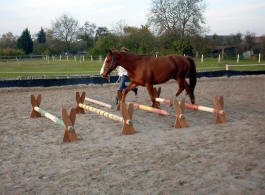 These
exercises are all designed for horses with some jumping
experience. If your horse is extremely green he probably
should not be attempting this exercise yet. However,
if he is slightly inexperienced or is an experienced
jumper but has not done much work over cavalletti you
can pull the first and the third poles in towards the
center line of the arena. This will produce a 9 ft.
(2.7 m) distance between two poles. Horses find this
exercise easier and will soon become stable and regular
at the trot, which is always your goal. You can then
put the four poles together and work in both directions
over four of them on the ground. After you have established
your horse's balance and rhythm here you can proceed
to the curved poles in B.
These
exercises are all designed for horses with some jumping
experience. If your horse is extremely green he probably
should not be attempting this exercise yet. However,
if he is slightly inexperienced or is an experienced
jumper but has not done much work over cavalletti you
can pull the first and the third poles in towards the
center line of the arena. This will produce a 9 ft.
(2.7 m) distance between two poles. Horses find this
exercise easier and will soon become stable and regular
at the trot, which is always your goal. You can then
put the four poles together and work in both directions
over four of them on the ground. After you have established
your horse's balance and rhythm here you can proceed
to the curved poles in B.