|
Equine Kingdom Riding Academy
is no longer in operation. These more than 2,000 unique pages are provided for historical and educational reference. |
||
 |
||
|
|
|





- Joint Health For Young Horses - |
|
By: Shannon Margolis
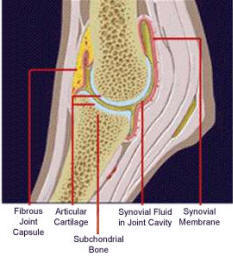
What Causes Joint Problems? Horses start developing joint problems (whether they are noticeable yet or not) when they begin training or exercising hard. When horses exercise hard, their bodies create more free radicals, which then uses up their supply of natural antioxidants at a faster rate. When the body has more free radicals than it has antioxidants, one area that suffers is the joint fluid, which changes in consistency and becomes thin. At this point, the joint fluid can't properly lubricate the joint, causing wear and tear on the cartilage. As the cartilage wears down, the joint becomes less and less stable. To compensate, the body lays bone down around the joint the stabilize it. At this point, the joint develops calcium deposits and you can see structural changes on X-rays. Creating Joint Health from the Beginning
One of the best and easiest ways to ensure that mare and foal get all the micro nutrients they need is to feed blue green algae because it's balanced in calcium and phosphorous. You can also feed the pregnant mare some alfalfa for its micro nutrient and calcium content, but don't feed alfalfa to young foals since it's not balanced in terms of calcium and phosphorous. Joint Health in Growing Horses To keep joints healthy in young horses, feed plenty of micro nutrients (from blue green algae, for instance), and avoid overloading the diet with too many calories. Studies have linked diets high in carbohydrates with developmental bone problems like OCD (Osteo Chondrosis Dissecans). Plus, overfed young horses that are too fat will overstress their joints with the extra weight. As a general rule, on young horses I like to be able to feel ribs but not see them. You'll also want to monitor their exercise regimen carefully. Young horses are not fully developed until they are 4 years of age. While you can certainly start working them earlier, they are not strong enough to handle heavy work until age 4. Joint Health in Horses Ages 4 to 6 At this age, horses are able to handle a full training schedule and start exercising heavily. To support this transition, feed plenty of good quality micro and macro nutrients, along with minerals and trace minerals. Since your horse is exercising hard, you'll also want to add in antioxidants to neutralize the free radicals being produced from the heavy exercise. Good antioxidants include blue green algae (which has beta carotene), Tahitian noni juice, super oxide dismutase (found in Cell Tech's Super Blue Green Algae), coenzyme Q10, grape seed extract, omega-3 fatty acids, and certain minerals such as sulphur (found in the supplement MSM). Stick with natural antioxidant supplements (i.e., those in their natural form) as much as possible since the body can use naturally occurring antioxidants more efficiently than synthetic ones. At this point in your horse's life you want to focus on good nutrition and antioxidants to prevent cartilage damage. Feeding joint supplements like glucosamine, which is a single component of the cartilage, is not as helpful. It will not prevent cartilage damage-antioxidants do a much better job of it. In fact, you want to delay the use of joint supplements as long as possible using the methods discussed above. Please note that it is not normal for horses to develop joint problems at this age. Joint problems at this age indicate a lack of nutrition, specifically antioxidants. There is an intravenous injection that supports the joints called Legend, which is hyaluronic acid. Hyaluronic acid can also be injected into the joints and is one substance that can be used to prevent cartilage damage and reduce inflammation after a joint has already been damaged. Hyaluronic acid will thicken the joint fluid and decrease inflammation in the joint (which is the result of free radicals and can thin the joint fluid). If your horse a little sore after a particularly hard workout or show, you may want to consider giving him Legend instead of going immediately to a joint injection. Remember that you can only give your horse so many joint injections in his lifetime, and that each injection increases the chances of introducing infection. Overall, if you have the choice, use excellent nutrition and antioxidants before resorting to joint injections. View their website at: http://www.horsegalore.com
|
 Joint
health is such a concern these days, especially for owners of performance
horses, that it deserves some serious attention. In this issue,
we'll be discussing ways to create and maintain good joint health
in young horses. While many horse owners now consider it normal
and acceptable to give joint injections to 4 and 5 year old horses,
my clinical experience shows me that horses should not need this
kind of support, if at all, until much later in life. With excellent
management and nutritional support, it's possible for even hard
working performance horses to have strong healthy joints for many
years.
Joint
health is such a concern these days, especially for owners of performance
horses, that it deserves some serious attention. In this issue,
we'll be discussing ways to create and maintain good joint health
in young horses. While many horse owners now consider it normal
and acceptable to give joint injections to 4 and 5 year old horses,
my clinical experience shows me that horses should not need this
kind of support, if at all, until much later in life. With excellent
management and nutritional support, it's possible for even hard
working performance horses to have strong healthy joints for many
years. One
of the best ways to create a foundation for joint health is to start
before the foal is even born. Make sure that the pregnant mare has
plenty of vitamins, minerals, and trace minerals throughout the
pregnancy so that the foal is develops good bones and joints. Once
the foal is born it is more difficult to supplement trace minerals
as he is nursing and mare's milk contains mainly macro minerals
like calcium. Be sure and start the foals on good micromineral supplements
as soon as they start to eat some grain especially if good quality
grass is not available.
One
of the best ways to create a foundation for joint health is to start
before the foal is even born. Make sure that the pregnant mare has
plenty of vitamins, minerals, and trace minerals throughout the
pregnancy so that the foal is develops good bones and joints. Once
the foal is born it is more difficult to supplement trace minerals
as he is nursing and mare's milk contains mainly macro minerals
like calcium. Be sure and start the foals on good micromineral supplements
as soon as they start to eat some grain especially if good quality
grass is not available.