|
 The
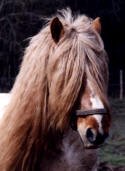
Poitevin, or Mulassier, originates in the Poitou region of France
and is believed to be related to the ancient primitive Forest Horse
of Northern Europe. The Poitevin is a singularly unprepossessing
animal that does not perform particularly well, has poor conformation,
and is rather unattractive. Having said that, however, they are
widely use din the production of excellent mules, at which they
excel! The Poitevin is believed to have descended from various Danish
and Norwegian Heavy horses that were probably imported to the regions
during the land reclamation work of the seventeenth century. They
can be used in draft capacity, and for working the land, but are
also used in the meat industry. The
Poitevin, or Mulassier, originates in the Poitou region of France
and is believed to be related to the ancient primitive Forest Horse
of Northern Europe. The Poitevin is a singularly unprepossessing
animal that does not perform particularly well, has poor conformation,
and is rather unattractive. Having said that, however, they are
widely use din the production of excellent mules, at which they
excel! The Poitevin is believed to have descended from various Danish
and Norwegian Heavy horses that were probably imported to the regions
during the land reclamation work of the seventeenth century. They
can be used in draft capacity, and for working the land, but are
also used in the meat industry.
In appearance, the Poitevin has a coarse,
heavy head with a straight or convex profile, set onto a very short,
muscular neck. The shoulders are quite straight and are poorly put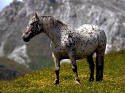 together. They are generally long through the body with a straight
back and sloping croup. The legs are very short in comparison to
the bulk of the body, and are also very thick with coarse feathering.
Their feet are large and flat, and their body hair is coarse. They
tend to be dun, a throwback to primitive roots, but can be gray,
bay, black, or palomino, and stand between 16 and 16.2 hh. Having
more or less written the Poitevin off, they have recently undergone
a revival in popularity as they are being crossed with Baudet do
Poitou jackasses to produce first rate working mules, called Poitevin
Mules.
together. They are generally long through the body with a straight
back and sloping croup. The legs are very short in comparison to
the bulk of the body, and are also very thick with coarse feathering.
Their feet are large and flat, and their body hair is coarse. They
tend to be dun, a throwback to primitive roots, but can be gray,
bay, black, or palomino, and stand between 16 and 16.2 hh. Having
more or less written the Poitevin off, they have recently undergone
a revival in popularity as they are being crossed with Baudet do
Poitou jackasses to produce first rate working mules, called Poitevin
Mules.
The Baudet de Poitou is an extraordinary
breed. It is a donkey, but can stand up to 16 hands high. They are
extremely hardy and tough, and they have the characteristic straight
donkey back, but have an amazingly quick, energetic stride for a
donkey. They have been carefully bred over the years to maintain
these admirable donkey traits and share their studbook, which was
started in 1885, which the Poitevin horse. Breeding Baudet de Poitou
jackasses with Poitevin mares produces the Poitevin mule. These
are strong, tough, and enduring animals with a long working life
and a good disposition and constitution. Since 1950, there had been
a reduction in the demand for mules, but recently there has been
a mule revival and Poitevin mules are again very much in demand.
Return to Horse Breeds page
|