|
 The
Andalusian is well known and one of Spain's most famous horses,
and it has a somewhat mysterious past. There are three different
explanations as to the origin of the Andalusian Horse, but whichever
you choose to believe, there is no denying that the breed is ancient. The
Andalusian is well known and one of Spain's most famous horses,
and it has a somewhat mysterious past. There are three different
explanations as to the origin of the Andalusian Horse, but whichever
you choose to believe, there is no denying that the breed is ancient.
 Firstly
and most likely, it is though that during the Moorish invasions
of the eighth century A.D., the Barbs and Arab horses belonging
to the Moors crossed with the native Spanish stock to produce the
Andalusian horse. There is also the theory that this breed is a
descendant of the 2,000 Numidian mares that the Carthaginian general,
Hasdrubal, shipped to Spain. Last of all, there is debate over whether
or not the Andalusian is descended from Equus Ibericus, which was
also influential in the development of the Barb. Firstly
and most likely, it is though that during the Moorish invasions
of the eighth century A.D., the Barbs and Arab horses belonging
to the Moors crossed with the native Spanish stock to produce the
Andalusian horse. There is also the theory that this breed is a
descendant of the 2,000 Numidian mares that the Carthaginian general,
Hasdrubal, shipped to Spain. Last of all, there is debate over whether
or not the Andalusian is descended from Equus Ibericus, which was
also influential in the development of the Barb.
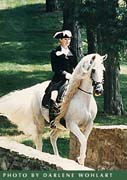 No
matter which one you choose to take faith in, there is no doubt
that the Andalusian has had influence on a tremendous number of
breeds. Their influence is seen in the Oldenburg, the Holstein,
the Frederiksborg, the Kladruper, the Lipizzaner, the Hackney, the
Friesian, the Old Norman Horse, the Orlov, the Quarter Horse and
the Criollo. No
matter which one you choose to take faith in, there is no doubt
that the Andalusian has had influence on a tremendous number of
breeds. Their influence is seen in the Oldenburg, the Holstein,
the Frederiksborg, the Kladruper, the Lipizzaner, the Hackney, the
Friesian, the Old Norman Horse, the Orlov, the Quarter Horse and
the Criollo.
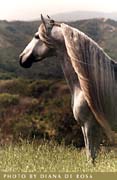
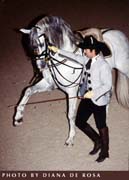 In
appearance the Andalusian has an attractive head with a broad forehead,
a straight or convex profile, and kind eyes. Their necks are quite
often thick, nicely arched, and set well onto good, sloping shoulders.
The chest should be broad and deep, the barrel rounded, the back
short and compact and the hindquarters muscular with a thick, low-set
tail. They tend to exhibit a tremendous presence and a spectacular
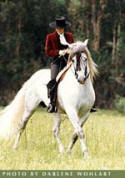
action, which includes the gait paso de andatura, a high-stepping
movement that was used in parades. In
appearance the Andalusian has an attractive head with a broad forehead,
a straight or convex profile, and kind eyes. Their necks are quite
often thick, nicely arched, and set well onto good, sloping shoulders.
The chest should be broad and deep, the barrel rounded, the back
short and compact and the hindquarters muscular with a thick, low-set
tail. They tend to exhibit a tremendous presence and a spectacular
action, which includes the gait paso de andatura, a high-stepping
movement that was used in parades.
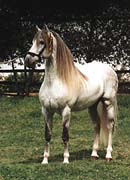 These
horses are docile and quiet, but are also energetic and brave, qualities
that have led to their frequent use in the bullring. They are predominantly
gray, black, bay, chestnut, or roan, and can stand anywhere between
15 and 16 hands high. The name Andalusian means 'the pure
Spanish breed'. These
horses are docile and quiet, but are also energetic and brave, qualities
that have led to their frequent use in the bullring. They are predominantly
gray, black, bay, chestnut, or roan, and can stand anywhere between
15 and 16 hands high. The name Andalusian means 'the pure
Spanish breed'.
Return to Horse Breeds page
|