- Avelignese - |
|||
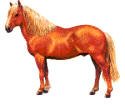
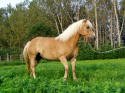
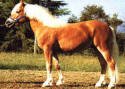
 The Avelignese gets its name from Avelengo, an area of the Alto Adige, which has been an Italian region since 1918. The Avelignese pony is Italy's version of the Haflinger. The two breeds bear a striking resemblance to each other. They are also both believed to be related to the ancient Avellinum-Halfinger and both breeds have bloodlines traceable back to the stallion El Bedavi. El Badavi was an oriental stallion bought by the Austrian Commission in Arabia. Although the Avelignese is considered a coldblood, and exhibits many characteristics of a coldblood, they do owe a debt to oriental influences. Today the Avelignese is widely bred throughout Tuscany, Emilia, and Central Southern Italy, although it is also found throughout Italy and is considered to be the most prolific Italian breed. They are very tough and enduring, which is due in part to the rocky, mountainous environments in which they were developed. They are larger than the Haflinger, both in height and stature, and are a good middleweight type. The Avelignese is a very versatile pony, and is used in harness for working the land in regions inaccessible to motorized vehicles. They are very surefooted over rough terrain and have exceptionally hard and well-formed feet. They are often used for both pack animals and for pony trekking. Their quiet, unflappable temperament, which is typical for a coldblood, makes them the ideal mount for children, novice, or nervous riders. Their very muscular frame makes them capable of carrying adults, and they typically make the ideal family pony. Although their build is fairly massive and stout, they are not unattractive and generally have good conformation. In appearance, the head is generally fine with quality. They have broad foreheads, with the head tapering to a fine muzzle. They are thick through the neck, which is short and very muscular, and they have powerful shoulders and are built for suitability for carrying a harness collar. The shoulder is quite upright, and the stride fairly short; they have broad chests and wide, compact backs. The hindquarters are muscular and well-rounded. Conformation of the legs is generally good and they have hard, dense bone, well-formed joints, and some feathering around the fetlocks. They are chestnut with a flaxen mane and tail and can stand only up to 14.3 hh.
The Black Stallion and Flame
Weatherbeeta Turnout Sheet/Fly Sheet Combo
Wahl "Pro" Rechargeable Clippers
|
|||
|