|
Equine Kingdom Riding Academy
is no longer in operation. These more than 2,000 unique pages are provided for historical and educational reference. |
||
 |
||
|
|
|





- Cheju - |
|
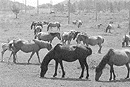
The Cheju horse is originally from the
Cheju Province, which is off the southern coast of Korea. It has
not been firmly established when and what type of horses were introduced
to the Korean peninsula, but it has been assumed that they came
from China. They are used for riding and light draft work and stand
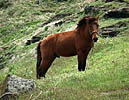
around eleven hands high. They are predominantly chestnut, bay,
and black, and are occasionally pinto, cream, gray, or white. They
have nicely shaped heads with straight profiles, large eyes, and
small ears. They have deep jaws that taper to a small muzzle, and
the neck is short and well-muscled. They have straight, short backs
and a gently sloping croup with a fairly high-set tail. The shoulders
are often straight and the legs seem to be all joints and tendons.
The Cheju pony shows influence from both the Arabian and Mongolian
horse breeds. According to a professor at the Cheju National University at Cheju City, it has not been firmly established when and what type of equines were first introduced to the Korean Peninsula; however, it is assumed that they came from China. Ancient records reveal that horses were the most important animals used for agriculture and military purposes from before first-century BC through the 14th and 19th centuries. This pony may have existed since prehistoric times, although there are no recording clearly confirming this. During the Korya dynasty (1276-1376), Mongolians governed the province of Cheju, and thus introduced their horses to the island. Supposedly, 160 breeding horses were brought from Mongolia to Cheju and used to improve the strain of native ponies. Since that time, the horses from Cheju have been exported across the mainland of Korea to China. The native ponies were used for crossbreeding as well, with Mongolian horses and some other exotic breeds in the areas. During the reining dynasties, the Cheju province was a profound horse breeding area; twenty five percent of the island's farm households produced horses. There were as many as 20,000 native Cheju ponies in Cheju at one point, but through the modernization of industries and farming and transportation, this number has been decreased to only 2,500 in 1989. The breed is in imminent danger of extinction. In 1987 the Korean government designated the Cheju pony as a National Treasure. The hardiness of these ponies is incredible to behold, and nothing short of amazing when considering its small size. They can survive severe winters without artificial shelter, and tend to be highly resistive to both disease and ticks. The mares are able to foal up to twenty or more years of age, and the ponies can carry loads up to 230 pounds.
Scrub Massage Bath Mitt
Tie Your Own Rope Halter Kit
Lead with Snap
|